Lucknow Gharana Of Kathak: History, Style, and Lineage!
The story of this Kathak gharana bloomed in the courts of the Nawabs of Lucknow. This gharana is renowned for its distinctive style of Abhinaya/ expressive storytelling and elegant skills. With the patronage from Nawab kings, the dance style of this gharana has a rich influence of Persian and Urdu culture.
This gharana is also known as the ‘Purab gharana.’ Many popular artists such as Lachchu Maharaj, Shambhu Maharaj, Birju Maharaj Ji, etc., came from this gharana. But have you ever wondered what made this gharana unique? Are you also excited to learn about the kathak style in this gharana? In this article, we will learn about the history, style, and lineage of the Lucknow Kathak gharana.
So, let us move ahead and know more about it:
History Of Lucknow Kathak Gharana
A Sankrit scholar named Shri Ishwari Prasad Mishra was a great devotee of Krishna. He was born in Lucknow in 1856. He used to live in the village of Handiya, situated in southeast Uttar Pradesh. His father taught him Kathak. His family was also a part of the Vaishnav Bhakti Movement (devotion to lord Krishna).
He received lessons in devotional poetry from childhood. The Bhajans (hymns), Geet (songs), and Thumri (ठुमुकना) from this poetry helped him to introduce an expressive style in Kathak. Once, lord Krishna appeared in his dream and told him to rejuvenate the Kathak dance. In the loving devotion of Lord Krishna, Ishwari Ji dedicated his whole life to developing this dance!
Ishwari Prasad started a school for teaching Kathak to his disciples. After the decline of the Mughal Empire in the early 19th century, his family relocated to Lucknow. The Avadh nawabs favored court dance culture. They gave patronage to his family.
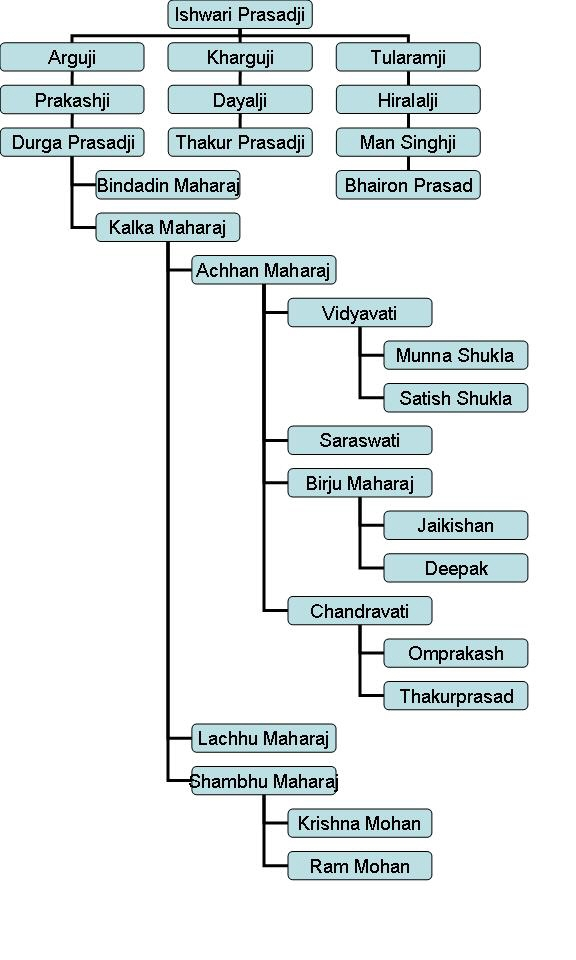
Let us learn about the lineage of Ishwari Prasad Ji and how his teachings shaped top dancers in this gharana:
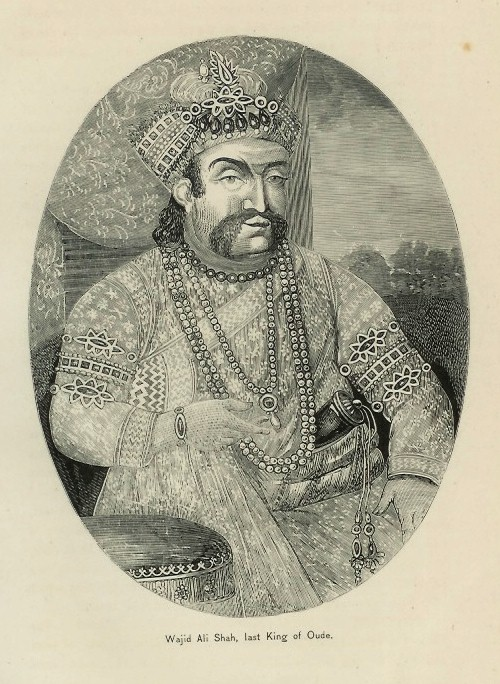
The Lucknow gharana of Kathak dance developed during the rule of Nawab Asaf-ud-Daula (1775-1798 A.D.) and Nawab Wajid Ali Shah (1847-1856 A.D.) of Avadh.
Ishwari Prasad taught this dance style to his three sons: Arguji, Kharguji, and Tularam Ji. He taught this dance till the age of 100. After his death, Tularamji decided to devote the rest of his life to spirituality, and Kharguji stopped dancing. Only Arguji continued teaching Kathak to his descendants- Prakashji, Dayalji, and Harilalji.
After Arguji’s death, Prakash Ji relocated to Lucknow. He was appointed as a court dancer in the court of Nawab Asfudaullah. He had three sons: Durga Prasad Ji, Thakur Prasad Ji, and Man Ji. Out of these three siblings, Thakur Prasad Ji was conferred the title of ‘acclaimed dancer.’ He also became the Kathak Guru for Nawab Wajid Ali Shah.
Nawab Wajid Ali Shah initiated the two distinct forms of Kathak: Rahas and Raas. He choreographed a dance using Kathak and called it the ‘Rahas. He used to dance on the beats of Rahas with his court ladies. This dance was more sensual and made for entertainment purposes.
Raas had a devotional aspect. It was a circular form of dance, where many milkmaids- gopis (at the periphery) danced with Krishna and Radha (at the centre). His guidance and hefty patronage took the Lucknow gharana to its golden era! The pair of Kalka-Bindadin brothers used to perform in his court.
Durga Prasadji also had three sons, named Shri Bindadinji, Shri Kalka Prasadji, and Shri Bhairon Prasadji. The pair of Bindadin-Kalka Prasad was famous for their amazing kathak skills. They were masters of every subject of this dance. These two legends were India’s best dancers at that time.
However, Bindadin Maharaj Ji had a poetic side with great composition skills. He was also a big Krishna devotee. In this devotion, we wrote many Thumris, Dadras, and Bhajans. These compositions later became a part of the Abhinaya section in the Lucknow style of Kathak dance. Here is one of the famous Thumri compositions of Bindadin Maharaj Ji from ‘Rasgunjan’ (page 6-7)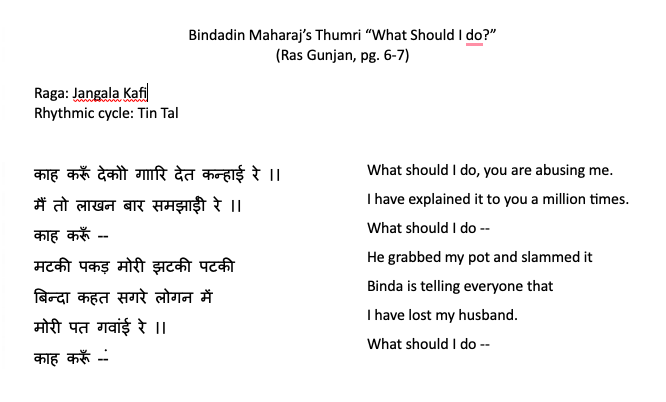 Kalka Prasad Ji had mastery in rhythm, Tabla playing, and Layakari. He also had three sons: Acchan Maharaj, Lacchu Maharaj, and Shambhu Maharaj. These three siblings were great exponents of Kathak. Achhan Maharaj was famous for his emotive style and lyrical footwork. He is the father of the legendary Pandit Birju Maharaj Ji, aka Brij Mohan Nath Mishra.
At the age of 4, Pt. Birju Maharaj started receiving Kathak lessons. His father and uncles, Lachhu Maharaj and Shambhu Maharaj, trained him. He dedicated his whole life to practicing and teaching Kathak dance. He spread Kathak on a global level with his teachings and choreography for films. Due to his valuable contribution, he received the Padma Vibhushan Award in 1986 (India’s second-highest civilian honor).
Pt. Birju Maharaj Ji was also appointed as a senior guru and director at the Delhi Kathak Kendra. In 1998, he opened his own dance school, ‘Kalashram’ in Delhi. He choreographed dances for many talented Bollywood artists, such as:
 Saswati Sen in Satyajit Ray's Shatranj ke Khiladi (1977)
Madhuri Dixit in Dil To Pagal Hai (1997), Devdas (2002), and Dedh Ishqiya (2014)
Kamal Haasan in Vishwaroopam (2012)
Deepika Padukone in Bajirao Mastani (2015)
Alia Bhatt in Kalank (2019)
With other gharanas, the Lucknow gharana also saw a decline in the British era. The British used to consider kathak performers as the ‘nautch girls’. The Nawab Wajid Ali had to give up the rule of Awadh to the British Empire. He moved to Kolkata.
The dancers in the Lucknow gharana struggled a lot after the loss of patronage from Nawab Wajid Ali Shah. They continued to pass their dancing skills orally to their descendants.
Even in tough times, the Kalka Prasad Maharaj Family continued their ‘Guru-Shishya’ tradition to keep Kathak alive in their upcoming generations. After independence in 1947, Kathak was revived in society. Kathak became a respected and valuable classical dance form.
In 1964, Kathak Kendra was opened in Delhi. Many Hindi film and drama producers started employing dancers from this gharana to choreograph dance in movies. Pandit Lachchu Maharaj Ji choreographed for world-famous movies like ‘Mughal-e-Azam’ (1960) and ‘Pakeezah’ (1972).

Pandit Birju Maharaj Ji sang and choreographed the famous song ‘Kanha main Tumse Haari’ in Satyajit Ray’s 1977 film, ‘Shatranj Ke Khilari’. He also choreographed another famous song, ‘Mohe Rang Do Laal’, for Deepika Padukone in the Bajirao Mastani movie. He received the Filmfare Award for Best Choreography in 2016 for this amazing work. He trained Aliya Bhatt for the song ‘Ghar Mohe Pardesiya’ in the movie ‘Kalank’.

Unique Style Of Lucknow Kathak Gharana
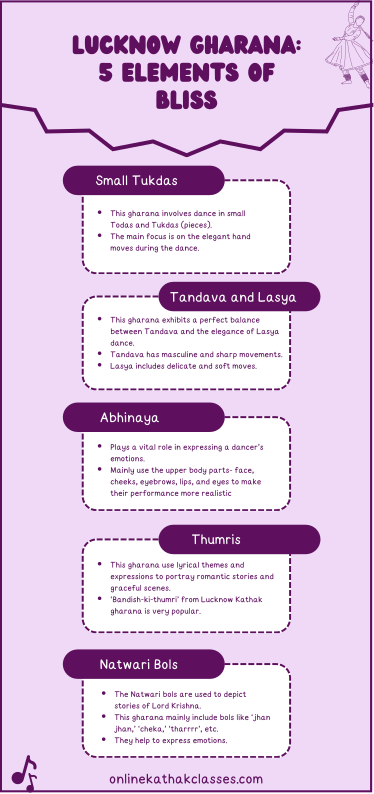
This gharana involves dance in small Todas and Tukdas (pieces). Dancers focus on the beauty of the body parts to present a graceful dance. The main focus is on the elegant hand moves during the dance.
The ‘Ta Thei Tat Thei ‘ are danced in many variations in the Tukdas of Tat. Also, the ‘That’ is expressed in a unique style.
This gharana exhibits a perfect balance between the graceful movements of Lord Shiva’s Tandava and the elegance of Lasya dance. The Tandava dance has masculine and sharp movements. Meanwhile, the Lasya dance includes delicate and soft moves.
Dancers may perform a powerful ‘Paran’ following with a smooth ‘Gat’.
A Parana is a rhythmic composition having syllables (bols) from instruments such as Pakhawaj and Tabla drums.
A Gat is a specific style of walk that dancers use to express scenes, characters, or a story.
Abhinaya plays a vital role in expressing a dancer’s emotions, mainly using the upper body parts. They exhibit expressive movements of the upper body- face, cheeks, eyebrows, lips, and eyes to make their performance more realistic!
Dancers trained in this can convey a wide range of emotions and stories flawlessly with their Abhinaya skills, intricate footwork, and Lysa!
Dancers from this gharana use lyrical themes and expressions to portray romantic stories and graceful scenes. Apart from thumris, this gharana has also incorporated various Hori, Dadras, Keherwa, Kajari, and Chaiti.
The ‘Bandish-ki-thumri’ from Lucknow Kathak gharana is very popular. This poetic composition is in Braj Bhasha and Urdu. It is a semi-classical vocal form with 6 Dadra or 8 Keherwa. It has a fast tempo and predetermined melody and lyrics.
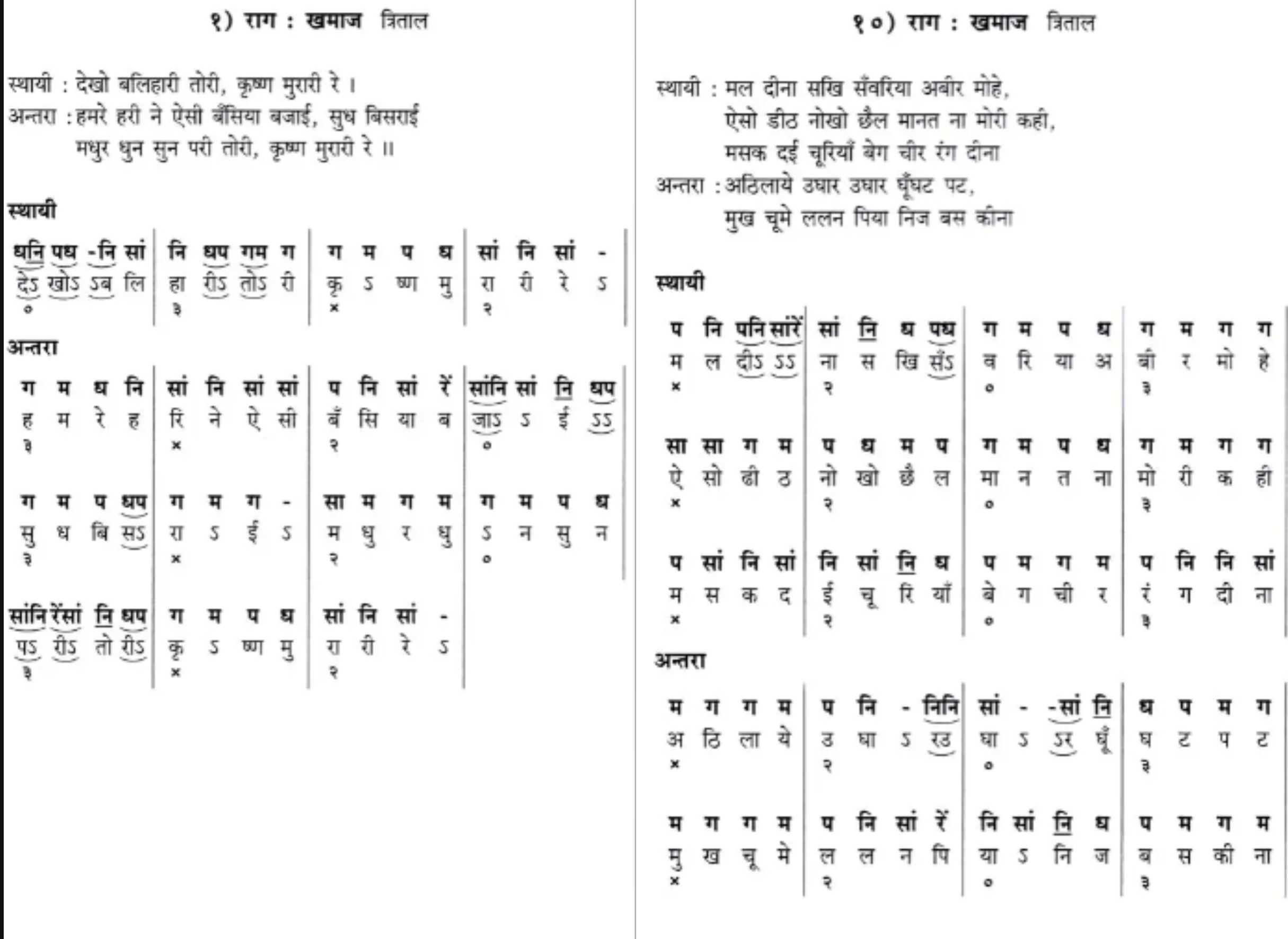
Pandit Bindadin Maharaj Ji was an exponent of composing and using thumris in Kathak.
Lord Krishna is often referred to as ‘Natwar’ or ‘Natwarlal’. The Natwari bols are used to depict stories of Lord Krishna. Pandit Janaki Prasad Ji developed these Bols.
With graceful moves and delicate footwork, natwari bols are perfect for expressing devotion to lord Krishna. For. e.g. these bols are used to depict Krishna’s dance during Kaaliya Daman.
These bols have unique vocabulary apart from Pankhwaj and Tabla bols. These Bols help to add a dynamic and powerful dimension to the performance.
Natwari Bols from this gharana mainly include bols like ‘jhan jhan,’ ‘cheka,’ ‘tharrrr’, etc. They help to express emotions in rhythmic patterns and moods.
FAQs
What Is The Contribution Of Pandit Birju Maharaj Ji?
He was a famous kathak guru and exponent in post-independence times. He started teaching Kathak at the age of 13. He took Kathak to international stages and spread the rich culture of India worldwide. He renovated this form by adding a contemporary touch and emotional depth to the style. He was from the Kalka-Bindadin gharana of Lucknow.
Who Was The Exponent Of Lucknow Gharana?
Pandit Bindadin Maharaj Ji was the most important exponent of the Lucknow gharana of kathak. He was a gifted dancer and poet. He composed more than 600 thumris for this gharana, which are still used in modern times. He used to perform with his brother, Kalka ji. The pair of these two siblings was the best in those times.
Conclusion
The devotion to Lord Krishna, a unique blend of Natwari bols, and Thumris has given a uniqueness to the Lucknow gharana of Kathak. Pandit Ishwari Prasad Ji set the foundation of this gharana. His lifelong efforts started the ‘Guru-Shishya’ (teacher-disciple) tradition for generations.
The contribution of Kalka-Bindadin Ji, Pandit Birju Maharaj Ji, Nawab Wajid Ali Shah, and Durga Prasad Ji is priceless! The magic of presenting stories with graceful Abhinaya yet powerful moves is only possible in this gharana.
Whether it is a balance of Shiva-Tandava and lord Krishna’s ‘Lysa’, Raas, or Rahas, the essence of the rich legacy is still seen in the Lucknow gharana of Kathak. And, this is what makes it unique!