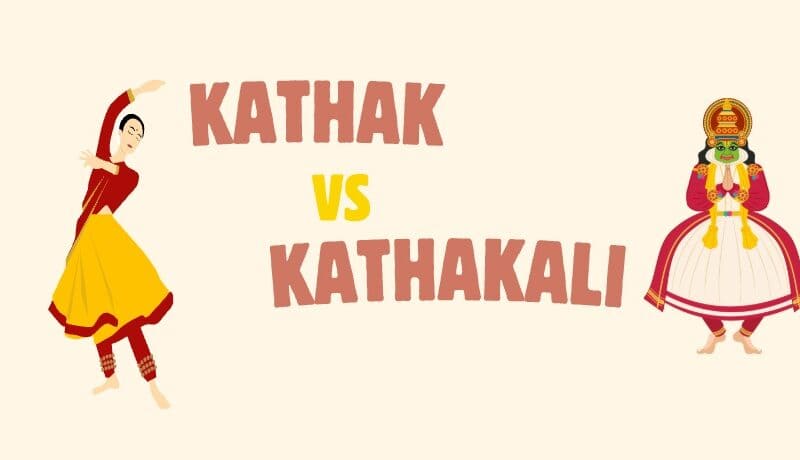
India is full of vibrant colors and cultures! From north to south, you can experience a range of variations in folk art, traditions, and much more! If you are a passionate dancer, you must have heard of kathakali and kathak. Some of us feel that these two dance forms are the same. These two Indian classical dance forms are two peas of a pod!
Kathak originated in North India; However, Kathakali was found in South India. Both differ in style, presentation, costumes, dance movements, and much more. These two forms have made an intricate impression on me when I first heard of them from my Guru. After that moment, I was unstoppable! I researched thoroughly and learned about them. In this article, I have explained the main differences between Kathak and Kathakali. If you are a beginner or thinking of learning one of these dance forms, this article is for you! Are you also excited to know more about the key differences of these dance forms?
Let’s begin!

Introducing These Two Dance Forms
Have you heard of Pandit Birju Maharaj, Sitara Devi, Shambhu Maharaj, or Kumudini Lakhia?
Yes! These are world-famous Kathak dancers!
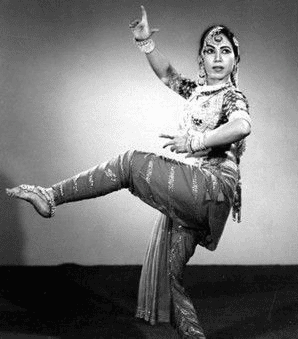
Originating from North Indian states, Kathak is one of the eight classical dance forms in India. In Sanskrit, ‘Katha’ means ‘story’. The person who narrates a story is known as the ‘Katthaka’ or ‘Kathakar’. Kathak dancers portray storytelling through this dance. Both males and females can learn and perform Kathak!
Kathak is renowned for its distinctive footwork, elegant hand movements, and expressive facial gestures. This dance form is famous for its rich history, many Taals, and strong beats.
Have you seen those dancers with green faces, white chins, heavy eye kohl, and big crowns on their heads? Yes! You guessed them right! They are none other than Kathakali dancers! This complex dance form comprises verses known as Kathakali literature or Attakatha. In Kathakali, males dress up and dance in the role of the theme’s heroes, heroines, gods, goddesses, demons, demonesses, priests, animals, etc.
Mainly originating from Kerala (the south-west state of India), Kathakali is known for its vibrant costumes, storytelling, and hand gestures! Kathakali dancers also depict stories while dancing with a graceful energy. These culture-rich stories are usually derived from the temples and folk arts of South India.
Main Differences Between Kathak and Kathakali
Historical Roots
They say, ‘Katha kahe so kathak kahave’
It means: Kathak is the dance of storytellers.
Kathakars are experts in performing Kathak synchronized with beats of Ghungroo, Tabla, Lehra, and Manjira!
This dance has been present since 400 BCE!
The most authentic and earliest historical source of this dance form is the Natya Shastra attributed to the sage Bharata. This ancient sacred text included 6 chapters and 6,000 poetic verses of performance art, and Kathak is a valuable part of it.
Kathak has three Gharanas(the main schools): Jaipur, Lucknow, and Banaras. Each Gharana has its own style of dancing and history of origin.
Lucknow Gharana
A Krishna devotee named Ishwari from the village in southeast Uttar Pradesh developed this dance, which led to the Lucknow Gharana. Initially, this gharana only had the auspicious Radha-Krishna theme dances.
Notable kathakars such as Shambu Maharaj, Birju Maharaj, and Lacchu Maharaj gave this dance form a modern touch.
Later, these performers also included drama-based choreography, including Kalidasa’s Shiva-Parvati, Bhavabhuti’s Malati-Madhav, the Hindu-Muslim Kathak fusion style, etc.
Jaipur Gharana
A famous Shiva Tandava dancer named Bhanuji visited Vrindavan (the holy ground of lord Krishna). He taught Natvari Nritya there. His grandsons, Laluji and Kanhuji, were inspired by the great love of lord Krishna.
These Krishna-devotee siblings returned to Jaipur and started the ‘Jaipur Gharana’. The Rajputs of Jaipur sponsored this school to spread the importance of the Hindu religion via this dance form.
Banaras Gharana
This is the oldest gharana among the 3. A famous dancer and a Sanskrit scholar named Janakiprasad was originally from a village near Bikaner. His family had notable dancers and musicians in the past. He relocated to Varanasi and started this school. He was the one who invented the ‘Bols’ of Kathak (Bols are the mnemonic syllables of this dance form).
KATHAKALI comprises two words- ‘Katha’ means a traditional tale/ story, and ‘Kali’ means art.
God’s Own Country, Kerala, had this ancient dance form around 16 or 17th century, almost 1500 years ago! Its exact year of origin is still not clear.
Kottarakkara Thampuran is known as the ‘Father of Kathakali’. He rooted this dance form in Kerala. He also developed Ramanattam, a dance drama based on the Ramayana. Depicting Indian Mythological stories, Kathakali is a perfect amalgamation of synchronized dance, classical music, and acting!
Like Kathak, Kathakali is also from the Natya Shastra. The inspirations for this dance came from Natya Shastra’s theory of Tāṇḍava dance (Shiva), the theory of rasa, of bhāva, keen gestures, dramatic expressions, acting, and standing postures.
South Indian states had temple art forms and theatrical traditions such as Ramanattam, Kutiyattam, Ashtapadiyattom, and Krishnanattam.
All these ancient performing arts used to depict stories from the Mahabharata, Ramayana, Gita-Govinda, Radha-Krishna, and important historical epics. Kathakali originated after taking inspiration from all these arts.
Do you know? The inspiration for powerful and energetic actions in Kathakali came from the Kalarippayattu, a type of South Indian martial art!
Dancing Postures
The basic Kathak dance postures are called the ‘Angas’. They include six main body parts, such as:
 Head (Shira)
Hands (Hastas)
Chest (Vakshas)
Sides/ flanks (Parshwa)
Waist/ hips(Kati)
Feet (Padas)
The rhythmic footwork is called ‘Tatkars’, and elegant hand gestures are called ‘Mudras’. Controlled body movement and aligned footsteps are the key to executing the most beautiful Angas!
While performing Kathak, you must keep your feet erect and perform graceful hand movements, which add an aesthetic appeal to this art! The feet should be slightly apart from each other to get proper balance and avoid unnecessary accidents while dancing.
The knees and hips must be in a straight line with the feet for synchronised movements. Your upper body movements, including your head, hands, and chest, add charm to the performance.
The important character/role types in Kathakali are segregated according to their makeup and costumes.
Pacha - Green: This role depicts the noble and exemplary characters of Ancient Kings, divine beings, gods, heroes, etc.
Kari- Black: It is black makeup with red and white highlights that represents evil or demonic characters.
Thadi- Beard: Thaadi includes various types of beards that represent different characters.
Vella Thadi: It is the white beard that represents lord Ram, lord Hanuman, and all other legendary heroes that were not evil in history.
Karutha Thadi: It is a black beard that depicts hunters and forest dwellers.
Chuvanna Thadi: It is a red beard that represents evil, demonic, and bad figures in Hindu mythology and scriptures.
Kathi- Knife: This represents arrogant and evil characters. The Kathi characters have a green face with red markings on the mustache area. You may have observed chuttippu, which is a small knob on the nose and forehead of these dancers.
Minukku- Radiant: Like this name sounds, Minukku represents the soft, gentle, spiritual characters of sages, Brahmins, Rishis, and women. These characters have subtle orange or yellow makeup with simple features.Mudras
Mudras are significant hand gestures performed while doing Kathak and Kathakali. Each Mudra has a unique meaning and symbolism.
The great sage, Bharat Muni, divided Kathak Mudras into three main forms:
Asamayukta: These mudras are done with only one hand. It has more than 30 Mudras, in which Pataka, Tripataka, Mayur, Ardhachandra, etc., mudras are quite famous.
Samayukta: These mudras are done using both hands. It has more than 20 hand gestures. Famous Samyukta Mudras are Paash, Chakra, Shankha, Shivalinga, Swastika, etc.
Nritta Hasta: These are the unique hand gestures/ Mudras in the technical dance. It has 30 subtypes. The most famous Nritta Hastas are Chaturasra, Swastik, Lata, Pallav, etc.Kathakali involves only 24 main Mudras that must be synchronized with facial expressions and body movements. These Mudras are taken from the sacred text called ‘Hasthalakshana Deepika.
The most famous Kathakali Mudras are: Pathaaka (flag), Mushti (Fist), Sukathundam (Parrot’s beak), HamsaPaksham (Swan’s wing), Anjaly (Salutation), Sarpasirassu (Serpent’s head), etc.
Footwork
Tatakar means footwork in Kathak. It involves striking both feet rhythmically on the floor. Your timing of lifting and striking each foot should be accurate to enhance the performance. These footsteps are not only about coordinated dance. They convey emotions, narratives, and the overall mood of the performance.
Kadhi Tatkaar, heal Tatkaar, and Vazan Tatkaar are some major footwork in Kathak.
Kathak dancers wear a belt of Ghungrus on their ankles. Dancers can wear 1 or 100s of these musical metal bells to amplify the sound of footwork! A Kathak teacher starts with slow ‘Laya’ footwork with their students. This eventually goes to double, triple, and four times for practice.
Like Kathak, Kathakali footwork is also connected with conveying emotions, characters, and stories. This dance form has powerful movements and rhythmic foot cycles (Tala). It is the most essential part for character development.
For e.g., a soft character like Minukku uses gentle, slow, and delicate footwork. Meanwhile, aggressive characters like Kathi involve forceful stomping, kicking, and jumping.
These dancers wear small anklets called “Thandapatta” at the base of the feet and Ghungroos at the knees. These musical additions introduce a lively dimension to the performance. They enhance the sound of rhythmic footwork.
Costume
Kathak has many types of costumes based on Hindu or Muslim characters.
Hindu dress of female dancers includes a saree around the waist, a Choli – blouse on the upper body, and a scarf (Orhani) if needed to cover the upper body areas. Or, they also wear a long, lightweight skirt which ends just above the ankle. A contrast Choli is preferred on the upper body and finally draped with a sheer scarf. The common makeup includes a Bindi on the forehead, gold earrings, necklace, dark lip shades, colorful bangles, etc.
Muslim dress for female dancers includes a skirt with skinny-fit chudidars. They wear full-sleeved blouses and a jacket. The head is covered with a matching scarf- Orhani. Their jewellery is simple, and their makeup is light.
Hindu dress for male Kathak dancers includes a silk dhoti draped around the waist. It is covered with a silk scarf. They may perform bare upper body. Some dancers also wear a Hindu white sacred thread, a sleeveless jacket, and simple jewellery such as a gemstone or pearl necklace.
The costumes differ according to the roles in this dance form. It involves headgear, vests, face masks, and painted faces. That is why all Kathakali dancers require 3-4 hours to prepare themselves before the performance.
All Kathakali characters wear voluminous skirts at the bottom of their outfit, except Minukku. Minukku characters wear warm yellow, orange, or saffron sarees to depict the role of Maa Sita, Radha, Panchali, and other goddesses.
Female Kathakali dancers wear white sarees with red jackets and an embellished scarf. They tie their hair into a top knot near the forehead. They don accessories such as necklaces, bangles, multiple Kadas, bold eye kohl, lots of Ghungroos- ankle bells, Mangtika, and Tika (the Bindi on forehead).
Music Choice
You can notice cultural differences in the music choices of these two dance forms.
India’s senior Kathak exponent, Mahamahopadhyay Dr. Pandit Puru Dadheech, reintroduced the Dhrupad (in Sanskrit, it came from Dhruv and Pada), an ancient musical genre in Kathak.
Kathak has vocal and instrumental pieces.
Its popular classical vocal forms are thumri, dadra, kajri, hori, etc. However, some Kathak performers also use ragas, darbari, devotional songs, Sanskrit Shlokas, and ghazals.
Instruments such as Tabla, Sitar, Veena, Pankhwaj, flute, Sarangi, Tanpura, etc., are used to create classical and semi-classical music for Kathak.
Kathak is all about rhythmic cycles of beats- TAAL! Teentaal has 16 beats, Roopak taal has 7 beats, Jhumraa has 14 beats, etc.
Kathakali music is Sopana Sangeetham, which is a perfect amalgamation of Carnatic music with rhythmic Taalas and Ragas! It is a type of Sopanam style of Kerala’s temple music tradition.
Kathakali vocalists perform live classical Carnatic songs in this style. The lead singer is called ‘Ponnani’ and their assistant singer is called ‘Shinkiti’. These artists sing in coordination to deliver the verses, which are called ‘Aattakatha’. They use Shruthipetti to balance their pitches.
The supportive orchestra uses instruments such as the Chenda, Chengilla, Maddalam, Ilathalam (cymbal), etc. The work of vocalists and musicians is coordinated to create a dramatic and narrative feel to the dancer’s performance.
Kathakali’s music involves potent Ragas such as Huseini, Paati, Samantha Malahari, Neelambari, Ahiri, etc.
The 5 main Taalas of Kathakali are atantha, chempa, chempata, muriatantha, triputa, and panchari. These Taalas depict various moods in the performances.
FAQs
Kathak Is Inspired From Which Gods?
This classical dance form is inspired by Lord Krishna, Radha Rani, Lord Shiva, Goddess Parvati, and so on.
Do Kathak and Kathakali Share the Same Facial Expressions- Navarasas?
Yes. These two dance forms have facial expressions in common. These 9 expressions are Sringara (love), Hasya (laugh), Karuna (sad), Raudra (anger), Veera (heroic), Bhayanaka (fear), Bibhatsa (disgust), Adbhuta (curious), and Shanta (peace)
Conclusion
If you are an enthusiastic learner or observer of these two dance forms, I hope you have gained a closer glimpse of the main differences between Kathak and Kathakali. They are not the same, but they represent the ancient cultures and traditions in India!
Whether it is origin, music, costume, mudra, or footwork, both dance types need consistent practice and devotion. What other differences do you notice in these two classical dance types? Do let me know in the comments!