Whether it is the jingling sound of Ghungroos or expressiveness in body gestures, each element of Kathak dance carries an exceptional historical touch! This dance form witnessed many dimensions of growth throughout the years. But to understand this history, one must know its beginning!
The tapestry of Kathak was woven in the state of Uttar Pradesh in northern India! This is one of the oldest dance forms in India, representing cultural heritage. It was believed to have originated around 400 BCE. The traveling bards of those times were called ‘Kathakars.’ They used to depict mythological stories through their dance performances! Initially, they spread this dance form in rural Indian regions. In the post-Mughal era, they relocated to dance hubs such as Jaipur, Lucknow, and Banaras to serve royals. It led to the creation of Kathak gharanas!
Feeling curious after reading about Kathak’s roots, right? To serve your curiosity, I have written this article on ‘the origin of Kathak’ so that you can learn about in which state, how, and when this dance form was founded. If you are interested in knowing about all of it, this article is for you!
Let us move ahead without wasting a minute and learn about this dance form in detail:
Origin Of Kathak
In Which State Was Kathak Found?
Uttar Pradesh is the home of Kathak! Studies say that this dance form was found in Benaras and later spread to the northwest to Lucknow, Jaipur, and other parts of northern India.
This dance shares a deep bond with Kathakars. The word ‘Kathakar’ means ‘the one who tells a story.’ These people used to travel in the villages of North India and perform dances in temples. The dance spectators in north Indian villages were the main audience for Kathakars.
This classical dance evolved in North Indian regions, like Varanasi (Benares), Lucknow, and Jaipur. Out of which Varanasi and Lucknow are in Uttar Pradesh itself! Jaipur is in Rajasthan (at that time, Jaipur was a princely state). These regions were a central hub for arts, music, and dance. Hence, the three main gharanas were also found in these three locations.
When Was Kathak Founded?
This dance form was found around 400 BCE.
Sage Bharata wrote the Natya Shastra. It was a sacred book that became the foundational text on Indian performing arts. Its first complete compilation is dated to between 200 BCE and 200 CE. (but, estimates vary between 500 BCE and 500 CE).
The Natya Shastra book has 6000 verses compiled in 36 chapters. This holy book describes the theory of Shiv Tandava, Rasa, Bhava, dance postures, acting techniques, etc. All of these skills are the main elements of Indian classical dances. And Kathak is one of the eight most ancient dance forms!
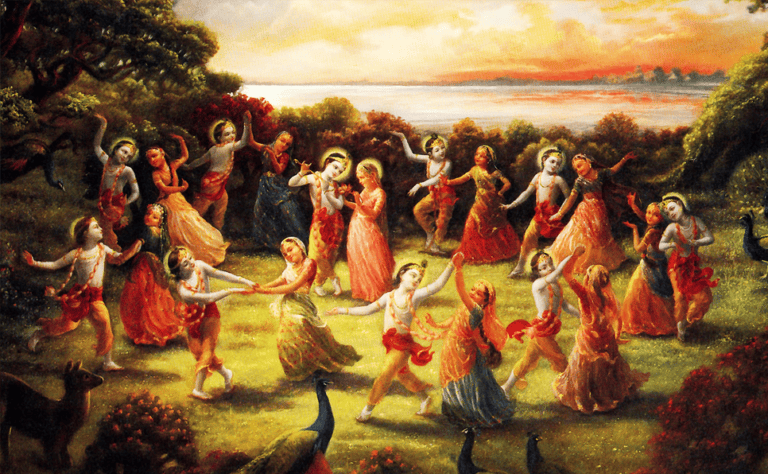
This dance form refers to the medieval period’s Raas Leela. It is a local dance-drama in the Braj region of Uttar Pradesh that depicts moments from the life of lord Krishna. This dance combines music, dance, and the narrative. Legends say that Lord Krishna used to perform Raas Leela with Radha and the milkmaids.

Not only this, but the description of Kathak has occurred many times in ancient texts. For e.g. the Adi Parva CCVI.2-3 of Mahabharata book states that:
वेदवेदाङ्गविद्वांसस्तथैवाध्यात्मचिन्तकाः।
चौक्षाश्च भगवद्भक्ताः सूताः पौराणिकाश्च ये॥२॥
कथकाश्चापरे राजञ्श्रमणाश्च वनौकसः।
दिव्याख्यानानि ये चापि पठन्ति मधुरं द्विजाः॥३॥
Which means:
Followed by the scholars of the Vedas and Vedangas, and by those who ponder on their soul, by persons skilled in music,
by the devotees of Bhagavata, (…)
by Kathakas (reciters of the sacred lore), by dwellers of forests, (…)
by those who sweetly recite celestial histories.
The holy texts of the Mahabharata were composed between 400 BCE and 400 CE. This ancient Indian epic had its final form during the early Gupta period, around the 4th century CE.
Another reference is the panels found in Bharhut (located in Madhya Pradesh, India). These sculptures are around 2,200 to 2,300 years old, dating back to the 2nd and 1st centuries BCE. These panels showcase the dancers in a vertical stance. These dancers have their arms in dancing positions.
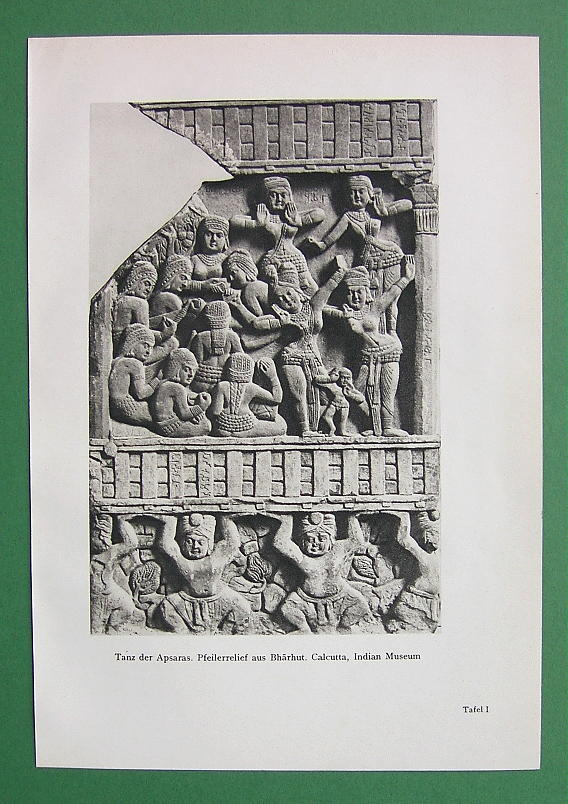
Out of these, many dancers have one arm near the ear, which shows the ‘pataka hasta’. These dancing stances indicate today’s Kathak movements.
So, you can sense how old this valuable dance form is!!
How Was Kathak Founded?
The word ‘Kathak’ originates from the Vedic word ‘Katha’, which means story. This dance form carries a significant ancient influence on the culture in North India.
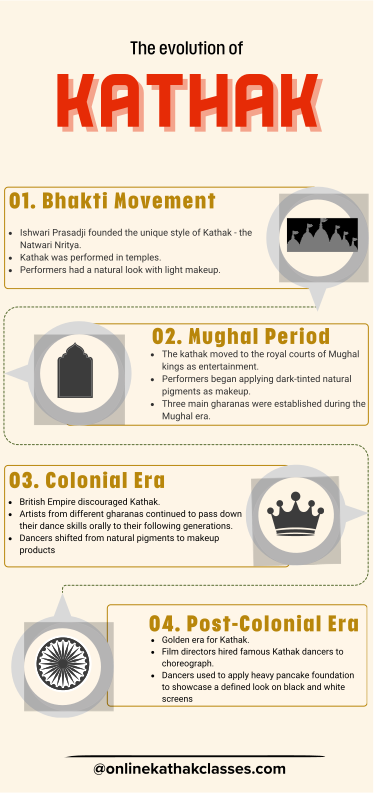
Kathak originated through the performances of Kathakars during the Bhakti movement. For them, dance meant devotion to God! They used to travel from kingdom to kingdom. They perform in local temples daily or on special occasions of Indian festivals such as Holi, Krishna Janmashtami, Radha Ashtami, etc.
These priestly storytellers would use music and expressive body movements to convey narratives orally to the audience. They were firm believers of Hinduism and Vaishnavism. Hence, their dance was mainly based on worshiping and expressing divine love for Lord Krishna. The other main characters in their performances were: Radha Ji, Maa Durga, god Shiva, goddess Parvati, lord Ganesha, etc.
Some of the stories were also from popular epics, like the Bhagavat Purana, Mahabharata, Ramayana, Shrimad Bhagavat, Indian mythologies, and legends.
The Bhakti Movement started in the 15th century. It was focused on devotion to deities like Krishna. This movement gifted Kathak with its own lyrics and musical forms. Lucknow was the capital of Awadh during the post-Mughal era!
Sri Ishwari Prasadji from the Handia village in Prayagraj, Uttar Pradesh. Once, lord Krishna appeared in his dreams and encouraged him to rejuvenate Kathak as a form of worship. Ishwari Ji dedicated his entire life to developing this dance form. He founded the unique style of Kathak – the Natwari Nritya. He taught his descendants. He moved to Lucknow in search of Patronage under the royal courts of Awadh.
Ishwari Ji’s descendants preserved the learnings of Kathak via an oral tradition for the next six generations. They brought unique Thumris and Ghazals in this style of Kathak. Later, it led to the formation of Lucknow gharanas.
On the other hand, Banaras is said to be the oldest root of Kathak! A Sanskrit Scholar named Janaki Prasad Ji studied Natya Shastra. He drew inspiration from the richas (couplets) of the Vedas and developed new syllables, which became the Natwari bols. These mnemonic syllables of this dance had bols like ‘ta, thai, and tat’. These bols are believed to be the main foundation of Tatkars.
Janaki Prasad Ji also developed a series of twelve compositions called ‘Barakhadi.’ This Barakhadi was the foundation for other compositions.
Janaki Prasad Ji was a gifted dancer from Bikaner who moved to Benaras! He established the core principles of the Benaras gharana style of Kathak. He passed his teachings to his following generations to keep this dance form alive.
The traces of Kathak also root in Vrindavan, a Braj Bhoomi region in Mathura of Uttar Pradesh. It is a popular sacred place for Hindus who revere Lord Krishna. The historical touch of Ras Lila weaved the modern style of Kathak!
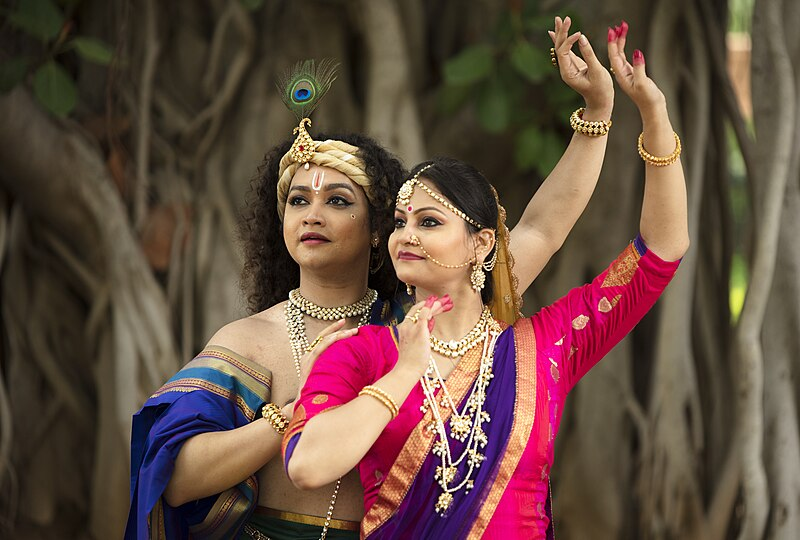
In 1526, the Mughal Empire was established in India. The kathak, which was performed in temples, moved to the royal courts of Mughal kings. There were distinct changes in the presentation and costumes of performers.
Under the Muslim Kings, this form of Kathak became highly stylized. Earlier, this dance was performed in the devotion of the Hindu Gods. The Kathak style in the Mughal era was more for entertainment purposes. The performers had to focus more on Nritya and Bhavag (graceful, expressive, and sensuous dimensions in this dance).
Later, this dance got a flavour of Persian and Central Asian themes, leading to a Hindu-Muslim style of Kathak!
The three main gharanas were established during the Mughal era and the British colonial period
Artists from the Lucknow gharana were under the patronage of the Nawab of Awadh.
Bhanu Ji Maharaj was a great Shiv Tandav performer. He went to Vrindavan and learned the Natwari dance. He taught this dance to his children. The Jaipur kathak style is a mixture of powerful gestures of Shiv Tandav Nritya and the grace and expressiveness of Krishna’s dance. After relocating to Jaipur, his descendants formed the Jaipur gharana under the patronage of the Sawai Kings.
Sukhdev Maharaj Ji was a descendant of Janaki Prasad of Beranas. He served the royal courts of Nepal and came back to grow the Benaras gharana.
After the Mughal decline, the British Empire discouraged Kathak due to its sensuous and expressive style. They believed that the Kathak associated with nautch girls (court dancers) was vulgar and immoral.
Eventually, this dance declined due to the ‘anti-dance’ or ‘anti-nautch’ stance of the Christian missionaries.
But the artists from different gharanas continued to pass down their dance skills orally to their following generations. These oral teachings kept the dance form alive.
In the post-British era, the ‘Kathak revival movements’ from different gharanas brought back this dance form to life. They brought scholarships, degrees, and colleges for kathak artists to institutionalize this dance form.
FAQs
Where Did Kathak Originate?
This dance originated in the Uttar Pradesh state of northern India. North Indian culture had a storytelling tradition through priestly storytellers called Kathakars.
How Did Kathak Get Its Name?
The word Kathak was derived from a Sanskrit word, ‘Katha’, meaning story. The people who used to tell stories were ‘Kathakars’. It started as an oral tradition. The Kathakars added gestures and mime to their dance to make it more expressive and meaningful.
Conclusion
This dance form was rooted in the sacred texts of Natya Shastra. Founders like Ishwari Prasad Ji from Lucknow gharana and Janaki Prasad Ji from Benaras gharana studied the descriptions in this book and gave birth to the Kathak dance form!
Originating from North India in 400 BCE, this dance has thrived for years! From temple performances to entertainers in royal courts, the kathak artists have kept this dance form alive for generations! Later, the three main gharanas (Jaipur, Banaras, and Lucknow) were formed with a unique style of presenting Kathak.
From the Bhakti Movement to the post-British era, Kathak has developed over the years! Likewise, the legacy of this dance will go on forever!