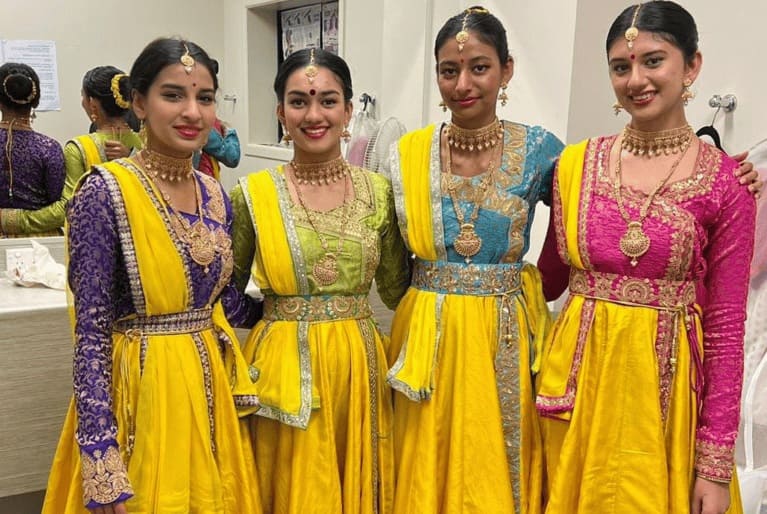
Wanna enhance your performance? Want to boost your confidence on the stage? Need to reflect your dance’s story/theme? A good costume does it all!
Proper dress selection is also an important part of Kathak. A breathable and lightweight dress is essential for easy movement, especially during fast spins and footwork. I feel these kathak attires are not just random dresses, but are a medium for cultural representation.
In this article, I have discussed the main types of Kathak costumes for male and female dancers. I have also emphasized how to choose these costumes and how they have changed over the years!

Types Of Kathak Costumes
Kathak costumes vary for both male and female dancers. Let us see what dress variety is available for them:
Kathak Costume For Women
Do you remember Madhuri Dixit in the ‘Kahe Chede Mohe’ song from the movie Devdas? She was wearing a rich red Lehenga for this kathak-style song.
A lehenga is an Indian flared skirt. This traditional outfit has heavy embroidery work. The lehengas are contemporary silhouette outfits and normally have a gold zari border. The voluminous flares are called ‘Gher’ in Kathak’s slang. These Ghers offer a delightful aesthetic to the performance, especially during fast spins.
Lehengas are worn at the high waist and tied with a knot or hooks. The more pleats, the more the Gher! These long skirts cover your lower torso to your ankles. Lehengas have mirror work and detailed detailing.
It is paired with a matching fitted blouse called ‘Choli’. These Cholis can be full-sleeved or half-sleeved, depending on your choice and comfort.
Female dancers also wrap a dupatta from their shoulders to their waist on the choli. These dupattas are long scarves made from chiffon, net, silk, tissue, cotton, etc.

Saree is a quick alternative to ‘Lehenga-choli’. Kathak sarees are made from pure cotton or linen fabric. These sarees are long pieces of lightweight natural fabric.
The sarees are paired with a matching or contrasting blouse on the upper torso and pajama on the legs.

Kurta Pajama is also a great option for sarees. Practice sessions are called ‘Riyaz’ time. Mostly, women wear a white cotton kurta/ tunic with contrasting pajamas (comfy slim-fit leggings).
The Kurtas can be of Lucknowi Chickankari, Pure cotton, Khadi, Linen, etc. Riyaz time involves continuous body movements. The sweat and tired feeling reduces while wearing such fabrics.
They pair this outfit with a matching or contrasting dupatta.

Have you seen Deepika Padukone in the song ‘Mohe Rang Do Laal’ from the Bajirao Mastani movie? She wore a cream-colored Ghagra with matching Choli and Dupatta!
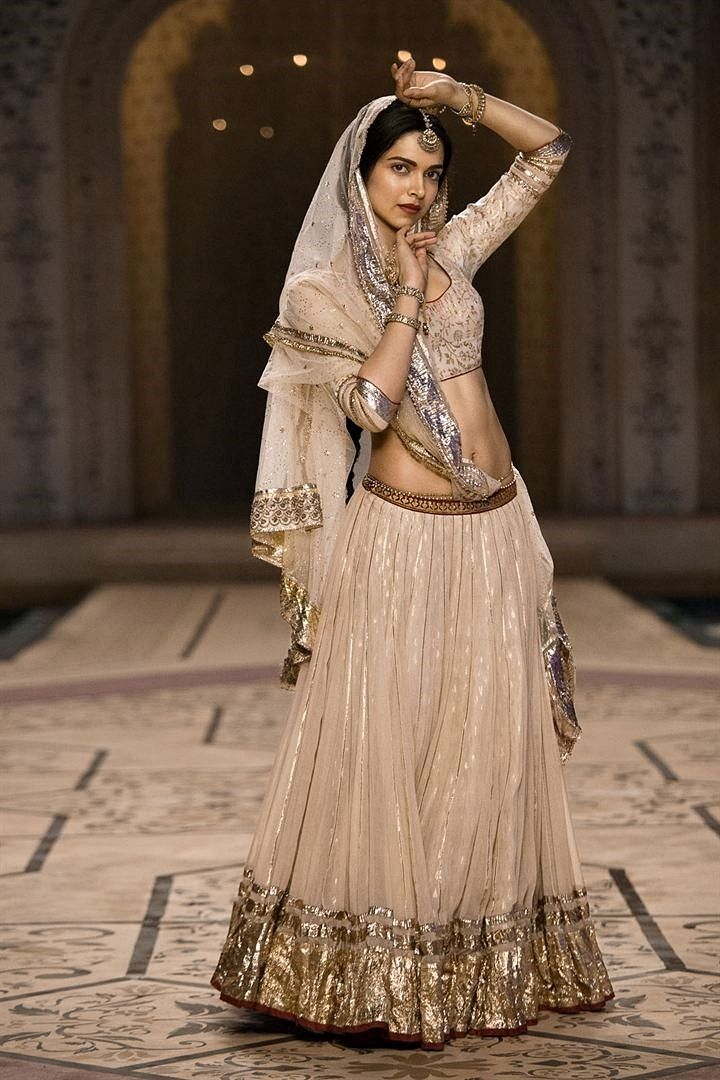
A Ghagra is slightly different from a Lehenga. It is also a skirt, but it has a relaxed shape flowing down from the waist itself. Meters of cloth are used to create a broad shape in Ghagras. These ghagras can be worn at the belly button or high waist. They are paired with a matching or contrasting blouse.
The designs of Kathak Ghagras slightly change according to the regions of India. For e.g. in Jaipur Kathak gharana dancers, you may see Bandhani work on ghagra pleats or mirror border on dupattas (due to the influence of the Rajasthani culture.)

A Dupatta is an unmissable part when donning a Ghagra or a Lehenga for your Kathak performance. These long pieces of fabric add to the visual appeal of the outfit! The trend of wearing a Dupatta originated in the Mughal era. The Persian women used to wear a Dupatta on their heads as a veil.
Sometimes, it is used as a prop to emphasize movements and express emotions for precise story narration. Some women dancers put it on their heads as a veil. Or, some dancers wrap it around the upper torso, from shoulder to bosom.

These charming outfits are popularly used in the Lucknow gharana kathak style! The name came from the Sanskrit word ‘anga-rakshaka’, meaning ‘limb-keeper’. Due to the influence of the Mughal reign and Nawabi culture, the Angrakha outfits were created. Dancers at that time used to wear an Angrakha with a visible midriff.
They donned it with sheer skirts and contrasting chudidars. This combination was preferred to fetch the attention of viewers. But the dancers were also able to show their skillful moves under these sheer outfits,
An Angrakha is a traditional tight-fitted tunic/ kurta. It is one-sided and tied on the waist with knots. Women dancers wear it with a contrasting colored lehenga and matching pajamas or Chudidars.

Angrakha outfits mostly have full sleeves. The corset-style knot helps dancers adjust and enhance their upper body posture during performance. The overall contrasting look gives an elegant appeal to their moves. Wearing a Dupatta is optional for these outfits.

Do you remember Rekha ji wearing a bright red Anarkali suit in the song ‘Dil Cheez Kya Hai’ from the movie Umrao Jaan?

An Anarkali is a long, flared frock-style kurta. It is combined with Kamarbandh, Dupatta, and Chudidar/ fitted trousers. Anarkali kurtas have intricate embroidery and Zari borders. These outfits also have a fuller flare/ Gher.
Kathak had a big cultural impact from the Mughal era. Mughal rulers brought the essence of Persian culture to this dance form, making it more bold and appealing. These outfits had detailed zari work on borders on rich fabric layers. Dancers wear a sheer dupatta or a small peaked cap on their heads while wearing this attire. These highlights still remind us of the royal Mughal era.
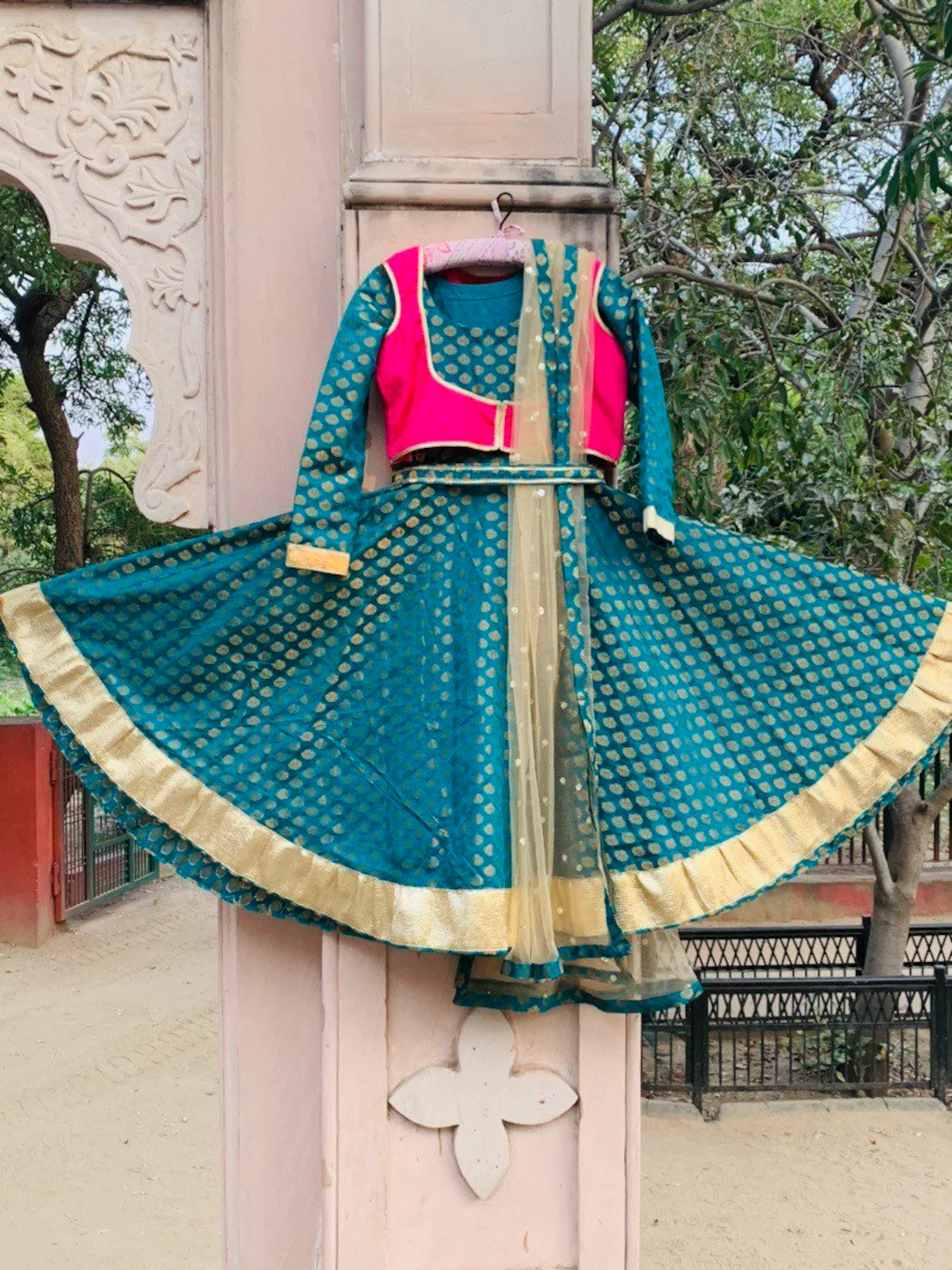
They are mostly made from silk or georgette. They have a flowing silhouette from the waistline. Some dancers also wear a waistcoat with this outfit to enhance the waistline.
Kathak Costume For Men
Male kathak dancers wear cotton, silk, or Khadi kurta to cover their upper body. They pair a dhoti or chudidar. A ‘Dhoti’ is a traditional wear that is wrapped around the waist and legs. You can use a long piece of Dhoti cloth to wrap it, or you can use a pre-stitched Dhoti.
Kurta can have full sleeves, half sleeves, or no sleeves. These loose-fitting Kurta may have a collarless or standing-collar shirt style. Their side slits at the waistline offer ease for movements during dance.

Kurtas have Front and Back panels in a rectangular shape that give a masculine appeal to the male kathak dancers. These kurtas fall to the knees or slightly below the knees. This fabric length offers a light flare to the outfit when male dancers perform round spins.
Some male dancers may only wear a Dhoti without a Kurta for performance. On wearing such attire, audiences can focus on the intricate upper-body dance moves of the shoulders, limbs, chest, and neck. Dhotis have pleats that offer a slight Gher on the legs.

Stitched Dhoti
A Chudidar is a great alternative to a Dhoti. It is a slim-fit pant/ fitted trouser without any pleats or a Gher. It is mainly made from cotton, silk, or linen fabric. It is lightweight and airy. Chudidars have knots to tie themselves on the waistline.
Kurta Pajama
Male kathak dancers also don a Kamarbandh or Dupatta around their waistline to make it more appealing.
Here is how you can wear a dhoti all by yourself:
Some dancers wear an Angrakha instead of a Kurta. Angrakhas have overlapping panels to tie at the side. It is tied with cords or buttons called Gundhis. Its overlapping panels create a unique, sharp, and asymmetrical silhouette on the male dancer’s body.
This style of outfit has a rich influence on Rajasthan’s culture. Hence, it is mostly seen in Jaipur’s Kathak gharana dancers. This outfit has historical royal elegance and cultural significance of Kathak.
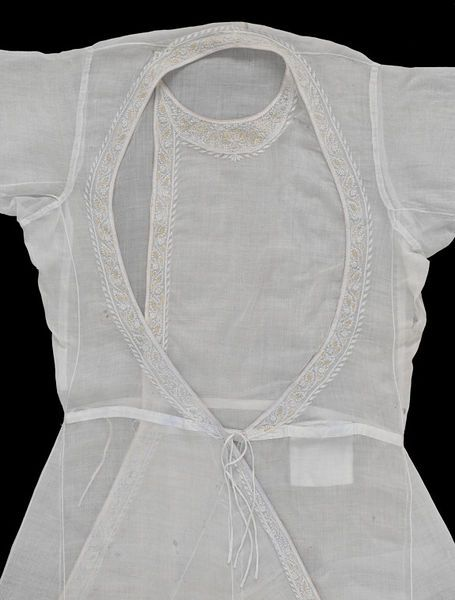
Round Angrakha Kurta

Angrakha Kurta with slits
These Angrakha Kurtas are made from pure cotton, linen, silk, etc. They have embellishments such as embroidery or metallic buttons.

These kurtas can be round or have slits on the sides. They have varying necklines such as V-shape, round, rectangle, etc. Men performers wear Chudidar, Salwars, or Dhotis on their legs with this Kurta. They also wear a dupatta around the waistline.
How Did Kathak Costumes Evolve Over The Years?
The Kathakars used to perform wearing Sarees (for females) and Kurta and Dhoti/ Pajama (for males). Some dancers were great devotees of Lord Krishna. They adopted attire in Ras-Leela, such as Ghagra Choli, Lehenga, Kurta, Kamarbandh, etc.

These dancers used to dress up as Lord Krishna, Radha, and Gopis (milkmaids) to narrate Krishna’s life stories through this devotional dance. The outfits at that time had a complete influence of Hindu culture.
Mughal rulers destroyed Hindu temples, leaving the Kathak artists unsheltered. So, these artists moved to the Mughal courts to work as court dancers. The Kathak’s original Hindu style, attire, and techniques received a touch from the Persian and Sufi dance.

The sarees were replaced with fitted Anarkali suits, Angrakhas, flowy lehengas, Cholis, and contrasting pajamas.
This dress had a slight midriff, sheer skirts, and a transparent veil. The outfits used to have intricate embroidery work, embellishments, and lots of Zari border. These changes made Kathak attire more stylish and attention-grabbing.


Slowly, Nawabs started dissolving their kingdoms to the British. Hence, the patronage for Kathak dancers also vanished. These officials referred to female kathak dancers by the name of ‘Nautch girls’ (devdasis or tawaifs).
The British colonials said that this dance was sensual, and its body movements were against social norms. So they banned the dance of Nautch girls. So, the Kathak teachers taught this dance form to boys to keep it alive for the next generations.

Boys wearing female kathak outfits for training
Kathak revived in India after the exit of the British rulers!
People started looking at it as a reputable classical dance form. Its sensual outfits got a contemporary touch. The zari, silk, and sheer fabrics shifted to cotton, linen, etc., fabrics. Dancers emphasized free movement and comfort in their outfits during performance.
Watch this video to know more about the journey of Kathak costumes:
FAQs
Which Accessories Are Used To Beautify Kathak Costumes?
Male dancers add Pagdis- turbans, Talwars (dummy swords), peacock’s feathers on the turban, Gunghroos, Dupatta, a small scarf as a headband, a sleeveless jacket, or Bansri (Krishna’s flute) to their outfit. Female dancers add a Dupatta (sheer veil), peaked caps, Ghungroos, etc., in their outfits.
How to Drape A Dupatta in Kathak?
Put the dupatta over the right shoulder. Let its one end fall on the left side of the waist. Adjust the length and pleats of the dupatta to get desired folds. Fix both ends of the Dupatta with a small safety pin or simply tuck its ends into your outfit. Tada! You’re ready to go!
Conclusion
Kathak outfits carry a rich history! Choose the outfit according to the story that you want to depict. In old times, these kathak attires had bold and heavy work. Over time, these outfits got minimal designs. All these outfits were designed to allow for the intricate footwork and graceful movements.
Whether it is a kurta-dhoti or a lehenga choli, each costume enhances the visual appeal of the performer. Which Kathak costume do you like the most? Do let me know in the comments!


