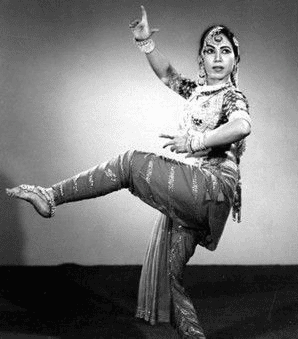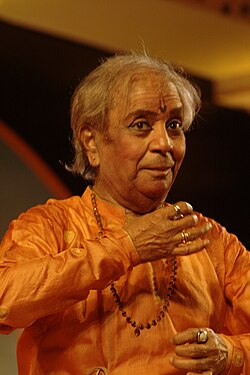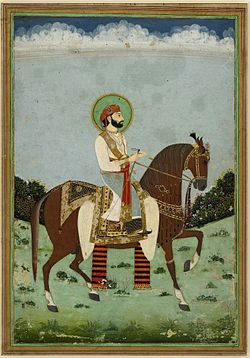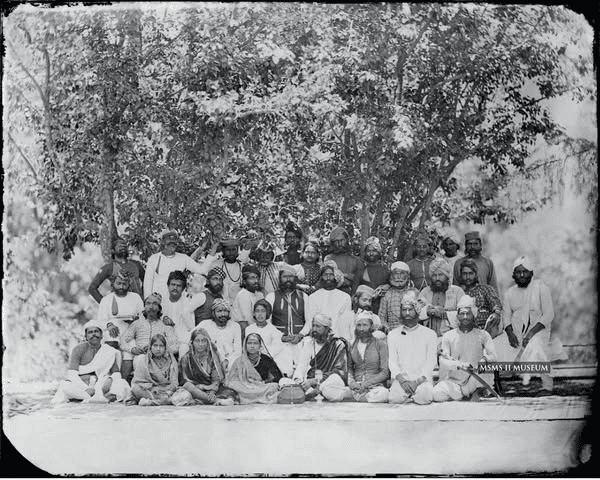
The hard work and devotion of generations in the three Gharanas: Lucknow, Jaipur, and Banaras, made Kathak a world-popular dance! Researching, developing, and spreading this skill was a challenge in the 18th and 19th centuries. The founders of these Gharanas faced backlashes and societal pressure from orthodox people at that time, especially when they trained female dancers.
This is when the Patrons of Kathak became the rescuer of Kathak! Many people in society recognized the true value of this dance form. They provided financial and royal support to the Kathak artists, writers, and musicians. The patronage of Kathak began with the Bhakti movement and continued till the post-independent era. From performing Kathak in temples to working in royal courts, the dancers have seen the segregation of this dance style and its evolution!
In this article, we will learn about these spectacular major patrons of Kathak who helped to keep this art alive! Let us move forward and learn more about them:

Patronage Of Kathak In India
The patronage of Kathak began in temples around the 8th century. India, being the land of cultural heritage, had the finest Kathak dancers in that era. Let us see how this journey went:
Kathak dancers in North India used to perform in temples. They depicted stories of Ramayana, Mahabharata, etc., through their performances. All these dances were performed for social and community purposes.
Kathak dance has a huge influence of Lord Krishna. Many dancers started performing due to their personal devotion to Krisha Bhagwan. They depicted the stories based on the life of Lord Krishna, his partner Shri Radha Rani, and the milkmaids Gopis in Vrindavan from the holy book of Bhagavatapurana.
These dances mainly included hand gestures and mime in Rasleela. Rasleela was a popular dance in the Braj region of Mathura, Uttar Pradesh, North India.
The Mughal Empire started in India around 1526. They were fond of dance and music. Rulers in this era used to invite Kathak dancers to their Hindu and Muslim courts to perform in front of royal members and their guests.
The Kathak in this era was a sophisticated form of entertainment. The dancers focused more on graceful, expressive, and sensuous moves.
Many courts of the Mughal Sultanate and Nawabs in Lucknow, Delhi, Banaras, Jaipur, Rampur, Murshidabad, and Raigarh supported Kathak dancers.
After the Mughals, the British and European people entered India. There was little influence of Asian-Persian culture on Indian tradition.
Kathak dancers were called the ‘Nautch girls’. These rulers discouraged this dance form due to Hindu criticism and Victorian morality of sexual repressiveness. British colonials banned the seductive gestures and facial expressions of Kathak performances in Temples and public gatherings.
To keep Kathak alive, Hindu families taught this dance to their descendants in private. Mostly, they preferred to train male dancers in this period.
After the exit of British Officials, Kathak Gharanas revived this dance form in Independent India. They started getting scholarships for their work.
Indira Kala Sangeet University in Khairagarh incorporated the oldest Kathak department in 1956. Puru Dadheech added the first-ever Kathak syllabus for an official degree.
Major Patrons Of Kathak
Studies tell that the earliest complete compilation of Kathak was from Natya Shastra and is dated to between 200 BCE and 200 CE. The sage Bharata made a treasurable contribution in creating these sacred verses of classical music.
Initially, Kathak was started in Banaras! Later, it spread to Jaipur and Lucknow. This dance was taught in the ‘Guru-Shishya’ tradition and passed through further generations.
Studies say that the Mughals, royals of Rajasthan, and Nawab Wajid Ali Shah were the noble patrons for the immense growth of Kathak during that era. Let us see the patrons of individual Gharanas:
Maharaja Anup Singh of Bikaner
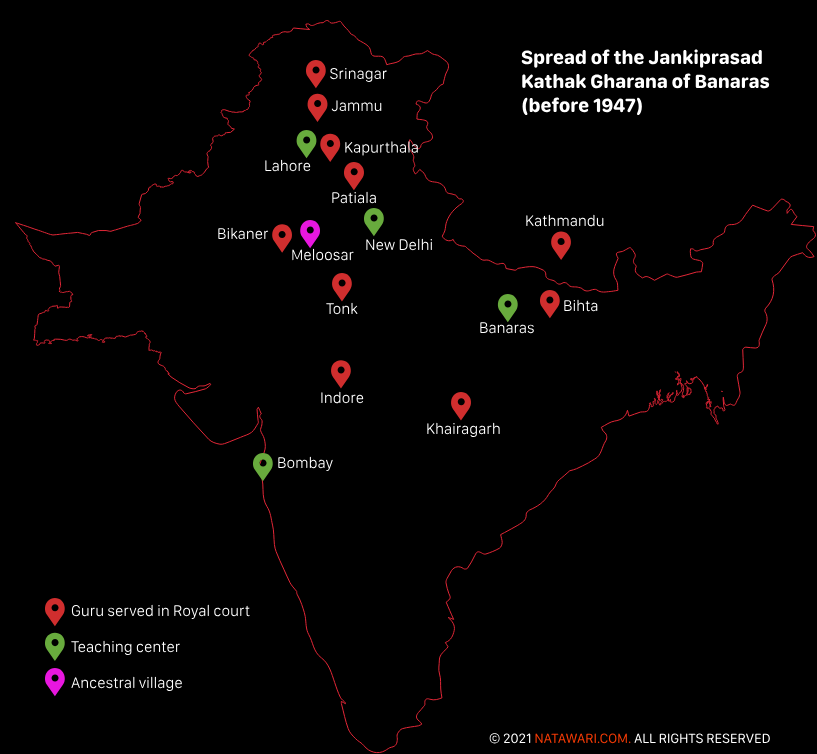
The lineage of Janaki Prasad Ji Gharana budded in the court of Maharaja Anup Singh of Bikaner! This king was a Rathore Rajput ruler of Bikaner between 1669 and 1698. He was a great patron of dance, music, and performing arts.

Shri Hukum Ji and his son Chunnilal Ji came to Varanasi when Maharaja Anup Singh Ji was the king. In those times, Chunnilal used to perform folk dances in the female roles. A notable Tabla player of Varanasi, Janaki Prasad, spotted his talent as a dancer and decided to teach him Kathak. Later, Chunnilal served the Bikaner court of Maharaja Anup Singh.
The royals of Jaipur were known for their passion and royal patronage for cultural arts and classical dance. Their firm support helped to form Jaipur’s Kathak Gharana.
These kings gave shelter to the Kathak dancers and supported their art for generations. This helped dancers to preserve the culture of Kathak. Let us see how these patrons help Kathak dancers of Jaipur Gharana:
The Mughals
In the 16th century, the Rajput Kathak community in the area of the Churu-Sujangarh was known as Shekhavati.
During the rule of King Akbar, many Shekhavati sardars served the Mughal court. With them, many skilled dancers and musicians were also appointed as court dancers. They received patronage from the Mughals. The dancers’ families flourished due to the financial help of the Mughal court.
In 1748 A.D., the scenario of serving courts changed after the death of Mohammed Shah Rangile. The Mughal king Aurangzeb came into rule, and all the musicians and dancers in the royal court again migrated.
They relocated to regions such as Lucknow, Murshidabad, Alwar, and Jaipur. Jaipur was one of the favorable states due to its rich cultural aspect and prosperous royal lineage.
Mid-to-late 17th century (c.1655–1690), a court dancer, Pundalik Vitthal, was famous due to his composition of ‘Ragamanjari. His work brought classical legitimacy to the Kathak dance in the Mughal period. After the end of the Mughal reign, he served the Amber court under Raja Madhosingh.
The Kachchwahas- Royal Kings Of Jaipur
Jaipur’s Kachchwaha rulers are known for their big hearts and welcoming nature for the arts and classical music. During the Mughal Sultanate period in the 16th century, 36 Karkhanas were formed to patronize cultural arts and music in India. This department thrived for the next 400 years under the rule of different Maharajas of Jaipur.
Gunijankhana was a place (they called it the ‘Karkhana’) where scholarly and gifted artists, dancers, musicians, etc., used to perform for the royals and local people.
Maharaja Sawai Ram Singh II (1833-1880) of Jaipur handled the Gunijankhana. Mohanrai was a skilled female Kathak dancer who served the court of Maharaja Sawai Ram Singh. She composed a poetic text including mythological and romantic stories called ‘Krida Vinoda’.
This Maharaja also patronized a female Kathak dancer named ‘Chandra’. She was appointed to perform in the temple and court festivities of the Jaipur durbar.
Records say that, during the rule of Maharaja Ram Singh, there were one hundred and sixty artistes employed, out of which some were Kathak dancers too. Their widows used to get a pension till death.

Maharaja Sawai Ram Singh’s successor, Maharaja Sawai Madho Singh II (1862-1922), continued his legacy. During his last years of ruling Jaipur, almost 8 families of Kathak were serving the court.
Maharaja Madho Singh II adopted a boy named ‘Mor Mukut’. After the death of Madho Singh II, Mor Mukut became the king. He was renamed as Maharaja Sawai Man Singh II. He was Jaipur’s last ruler. A courtesan named Jadonji was a patronized female Kathak dancer in his court. He gave payroll to 10 Kathak male dancers during his period of service.
His son, Maharaja Sawai Bhawani Singh, revived the Gunijankhana.
Maharaja Jagat Singh II was known for his patron support for dancers, musicians, and courtesans. A female Kathak dancer named Raskapoor served his court and was known for her influence in royal society. Some female dancers under his reign were appointed to perform daily in the Govind Devji temple in Jaipur. They received a fixed stipend from the state.
Pandit Jai Lal Mishra was appointed as the Kathak dancer in the Jaipur Darbar (between 1885–1945). Later, he also served the courts of Jodhpur, Ramgarh, Sikri, Maihar, and Nepal. He is known for his contribution to spreading and popularizing Kathak in various parts of India.

Later, Kathak families of Pandit Shri Bhanuji, Hanuman Prasad, and Hariprasad served the royal courts of Jaipur. These dancers were famous for their unique presentation of ‘Shiv Tandava’ through Kathak.
From the mid to late 90s period, Jaipur Kathak gharana remained under the patronage of Gunijankahan. Many prominent Kathak dancers, Shyam Lal Ji, Nathu Lal Ji, Badri Prasad Ji, Chunni Lal Ji, Lakshminarayan Ji, etc., flourished

Gunijankhana: now known as, Maharaja Sawai Bhawani Singh Jaipur Museum Society
Pandit Birju Maharaj, Shambhu Majaraj, Lachhu Maharaj, etc., are the great dancers from the Lucknow Gharana of Kathak! A prominent Sanskrit scholar, Krishna devotee, and dancer, named Ishwari Prasad, attributed the Lucknow Gharana! He developed the iconic ‘Natwari Nritya’ in this Gharana.
This gharana was based on the devotion for the love of lord Krishna and Shri Radha Rani. The Mughal Empire collapsed. So, some court dancers in the Mughal Courts moved to Lucknow. The Avadh nawabs of Lucknow favored court dance culture. This helped the skilled dancers to survive in tough periods.
The 11th and Last Nawab of Awadh- Wajid Ali Shah

This was the golden age of Kathak due to the patronage of Nawab Wajid Ali Shah. He reigned from 13 February 1847 to 11 February 1856. He was a great poet, dancer, and patron of folk art, classical dance, music, and art.

The dancers who used to perform Kathak in courts were called Tawaifs. They used to perform on dadra, kajri, thumri, and tappa. Nawab Wajid Ali Shah added a new dimension to this dance.
He incorporated literature, added rasa and bhava, and categorized it into two forms: Rahas and Raas.
He choreographed Rahas and added acting, drama, and the whole setup of scenes in this style. He also used to dance with court ladies on Rahas. He added new Ragas and presented Kathak in a new blend of emotions and acting for Indian Classical Music. He also founded Parikhaana, a training school for women performers.
Raas was based on Lord Krishna’s dance with Radha and the gopis. It had a religious touch. Due to his expertise in Kathak and royal patronage, Kathak gained so much popularity. Legendary Kathak performer Thakur Prasadji was his Kathak guru.
The famous brother duo, Kalka Prasad ji and Bindadin Maharaj Ji, also performed in Nawab Wajid Ali Shah’s court.
Thakur Prasad Ji also served the courts of previous Nawabs such as: Nawab Nasir-ud-Din Haider (1827–1837) and Nawab Ghazi-ud-Din Haider(1819–1827).
Nawab of Rampur- Hamid Ali Khan (reigned 1896-1936)
Rampur Court continued the legacy of Mughal traditions. Nawab Hamid Ali Khan was a notable patron of classical music and performing arts during the late colonial period in India. He sponsored the artists and musicians of Rampur-Sahaswan Gharana.

After 1856, the court of Awadh declined, and many court performers relocated. Nawab Hamid Ali Khan gave refuge and financial support to these dancers from the Lucknow Gharana. He also supported the ‘Guru-Shishya Parmapara’ of gharanas.
Bindadin Maharaj, a court performer of Nawab Wajid Ali Shah, got the patronage from Nawab Hamid Ali Khan. This Nawab sponsored daily Mehfils of these performers! Similarly, other skilled performers such as Acchan Maharaj, Kalka Maharaj, Lachhu Maharaj, etc., also served his court.
FAQs
How Did Mughals Patronize Kathak?
They transferred Kathak performances from temples to royal courts/ durbars. They added Persian and Islamic elements to this dance. They added rhythmic music, costumes, and gestures. The dancers used to get a stipend and royal support for their work.
Where Did The Nawab Wajid Ali Khan Reign?
He reigned at Awadh, a region of Uttar Pradesh, North-east India. He was the last and 11th king of Awadh. He patronized Kathak on a great level.
Conclusion
Kathak carries a rich history of patronage from royal kings, Nawabs, and Mughals. These kings had a strong belief in classical music, art, and dance. That’s why they supported talented Kathak performers in their reigns.
Whether it is Nawab Wajid Ali Shah, the Royals of Bikaner, or the Sawai Kings of the Kachchawa dynasty in Jaipur, all these major patrons of Kathak knew the importance and glory of this dance form. Due to their prominent support and financial help, Kathak performers were able to keep this dance form alive!